01 · Understand
Scope, organizational context, strengths, findings, contrary evidence and unresolved questions. Show what is known and how securely it is supported.
Proposed CORE offering · Report & improvement program
A clear account of where you stand, what supports that judgment, and how to make the next improvement happen.
Illustrative report sample. All findings, measures and work packages below are fictional.
The customer receives
Executive insight and detailed findings, backed by an evidence register and an editable work breakdown structure (WBS).
Retain the baseline. Assign the action. Revisit the outcome.
Proposed service · not yet commercially availableDesigned for leaders who need direction and teams who need an executable brief.
Scope, organizational context, strengths, findings, contrary evidence and unresolved questions. Show what is known and how securely it is supported.
Strategic implications, options, trade-offs, applicable framework mappings and priorities. Separate urgent risk treatment from achievable early improvements.
Work packages with accountable owners, dependencies, effort assumptions, milestones and acceptance evidence. Review whether the intended benefit occurred.
Sample executive report · Fictional institution · Draft 01
CORE findings explain the situation. The capability profile summarizes assessed practice. Framework alignment identifies relevant external criteria.
01 · Capability profile
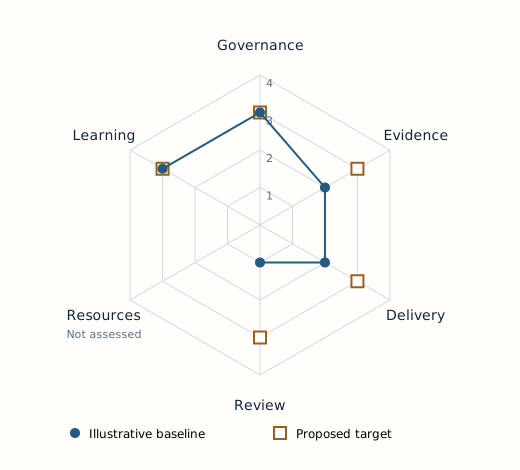
Open squares: proposed targets, not external benchmarks. The break at Resources means unassessed; it is not a zero. No aggregate score is calculated.
Illustrative rubric: 1 informal; 2 defined; 3 consistently applied; 4 reviewed and improved. Assign a level only after checking dimension-specific evidence against agreed criteria. An engagement would agree the applicable rubric before assessment.
02 · Executive understanding
The fictional evidence suggests clearer governance than outcome review. A small support-process pilot is proposed before wider change. It would be premature to attribute learning outcomes to these scores.
F-EDU-002 · Maintain clear ownership; verify in a wider sample.
F-EDU-001 · Improve referral records and validation.
F-EDU-001 · Trial a shared handover protocol.
F-EDU-003 · Establish outcome and workload measures.
No rating, target or inferred deficiency. Agree additional scope first.
F-EDU-002 · Retain team reflection and test whether it changes practice.
Evidence support is provisional across this fictional sample and is separate from each capability rating. Targets require sponsor agreement.
Alignment is not a radar score. Each row needs a verified reference, applicability decision, evidence and reviewer judgment. ISO 55001 and GFMAM references here concern potential asset-management scope; they are not substitutes for educational criteria.
| Reference / scope | Relationship to CORE findings | Status and next step |
|---|---|---|
| Local objective O-01 Timely, reviewed support | F-EDU-001 and F-EDU-003; evidence E-01/E-02 supports investigating process gaps | Proposed objective; institution confirmation pending. WBS 1.1 validates criteria. |
| ISO 55001:2024 Potential campus asset-management scope | No clause mapping for the learning-support findings. Assets were outside this sample. | Not assessed. Confirm scope and review applicable requirements before any alignment judgment. |
| GFMAM Landscape, third edition Potential asset-management subjects | No subject-level mapping asserted. Capability axes are CORE's proposed dimensions, not GFMAM subject ratings. | Mapping pending scope review. Record subject, edition, evidence and reviewer when assessed. |
Basis: fictional E-01: eight of 12 referral records lack a review date; E-02: staff describe differing handovers. Missing records do not prove absent support.
Action: validate the sample, agree a protocol and trial it with one team.
WBS 1.1–1.3 · View program ↓Basis: fictional E-03: four team meeting records name owners and document reflection. Wider consistency is untested.
Action: retain these practices in the pilot, check implementation and avoid duplicate governance.
WBS 1.1–1.2 · Validate and retain ↓Basis: fictional E-04: the sampled review template has no outcome or workload measure; other records may exist.
Action: establish baseline measures before the trial and compare them at review.
WBS 1.1 & 1.4 · Baseline and verify ↓Traceability: objective → evidence → finding → applicable alignment → recommendation → WBS → acceptance evidence → benefit review. Strengths, uncertainty and non-mapped findings remain visible.
Interactive report example · fictional educational institution
This example concerns the institution’s ability to respond to learning needs. It does not describe an assessed school.
Educational institutions · proposed application
Assess how goals, people, support processes, resources and governance enable learning. Examine the connection between institutional decisions and learner experience.
CORE: institutional capability, resource decisions, support delivery, governance, facilities and improvement effectiveness.
iSTEMS: individual aspirations, baseline understanding, accessible experiences and demonstrated development.
Institutional reports would use appropriately governed, minimised evidence. Individual learning records would not automatically become institution-wide reporting data.
Explore the individual learning experience →Each mapping would identify the framework, edition, relevant requirement or subject, applicability, evidence, assessor rationale and review status.
ISO 55001:2024 addresses asset management system requirements. The GFMAM Asset Management Landscape, third edition, describes the discipline’s subjects and fundamentals.
Use these where asset management is within scope. A thematic relationship does not establish conformity or certification.
ISO reference ↗ · GFMAM publications ↗Select and verify sector-specific criteria before assessment. Do not force a learning-support finding into an asset-management standard.
Record “not assessed”, “not applicable” and “mapping pending review” explicitly. Any assessment would state its scope, evidence and limitations.
Proposed engagement
Agree the decision, boundaries, evidence access, assessment criteria and intended users of the report.
Examine documents and operating practice; test interpretations with stakeholders; preserve disagreement and evidence gaps.
Deliver an approved dated report, evidence and alignment registers, and an editable WBS. Agree owners, resourcing and acceptance criteria.
Compare new evidence with the baseline. Separate completed tasks from demonstrated benefits, and retain prior report versions.
The reporting approach is in development. Discuss your context and what an assessment would need to support.